Most materials expand when heated and contract when cooled, but some, like water, expand when cooled (0-4°℃).This so-called ‘NTE' is just one property that solid state scientists at USTB are exploiting in their quest to develop materials with useful qualities. These properties include the ability to stay the same size under extreme heat, and also the ability for materials to remain polarized for extended periods in the absence of an electric field, a phenomena known as ‘spontaneous polarization.
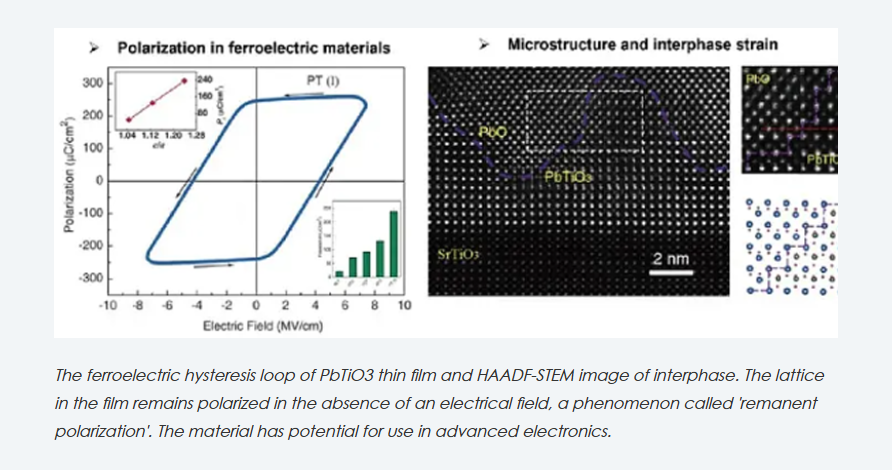
The ferroelectric hysteresis loop of PbTiO3 thin film and HAADF-STEM image of interphase. The lattice in the film remains polarized in the absence of an electrical field, a phenomenon called 'remanent polarization'. The material has potential for use in advanced electronics.
"By controlling materials at the atomic level, we aim to create things we haven't even dreamed of yet," says XING Xianran, Professor and the Director of USTB's Institute of Solid State Chemistry."Think of ultra-fast information storage, sensors capable of withstanding extreme conditions, or robust panels for aircraft. "The Institute of Solid State Chemistry, USTB, is well placed to achieve those goals. Established in 2019, it has quickly become a prominent player in solid state chemistry research.
Support from China's National Key Research and Development Program –a major initiative aimed at fostering technological advances in key strategic areas - has allowed the institute to facilitate and establish advanced facilities such as the Scattered Neutron Source test platform, which is used to explore the internal structure and dynamics of materials.
An example of Solid Chemistry Institute researchers rising to that challenge is in the exploitation of NTE in ferroelectric materials —materials with the quality of spontaneous polarization. In the early 2000s, XING and his team revealed the mechanism of NTE in a classic ferroelectric material, lead titanate (PbTiO3), in temperatures up to 490 ℃1. The research, covered in the journal Chemical Reviews in20222, found that shifts in temperature trigger a specific atomic rearrangement called ferroelectrostriction (SVFS) which causes the materials to shrink upon heating.