Society relies heavily on advances in materials science, with applications spanning spacecraft and infrastructure, to automobiles and LED lights. Increased demand for new and better materials calls for scientists to embrace technologies such as big data and artificial intelligence for material discovery, design, and manufacturing.
One of the trailblazers in this field is the University of Science and Technology Beijing (USTB). Founded in 1952, USTB was initially the Beijing Institute of Iron and Steel Technology, and has long been known as the ‘Cradle of iron and steel engineers.’ Witnessing China’s transformation into a giant steel consumer and the world’s largest steel manufacturer, USTB is moving even faster with cutting-edge technology and big data to “increase the efficacy of advanced materials and processes from start to finish,” says XIE Jianxin, Director of the Beijing Advanced Innovation Center for Materials Genome Engineering at USTB, an Academician of the Chinese Academy of Engineering, and an esteemed materials scientist.
Engineering materials
USTB was one of the pioneers in China in applying data and AI-powered materials genome engineering (MGE) for materials discovery and development. Materials genome engineering is analogous to genome engineering in biology in a conceptual sense, an approach integrating computation, experiment and big data to support materials design and discovery. The traditional trial-and-error method for materials design “is costly, time-consuming, and often less informative,” says XIE. “The advent of MGE altered the whole process of the materials industry. Harnessing the power of materials data can speed up discovery, enabling on-demand design and precise control of materials characteristics.”
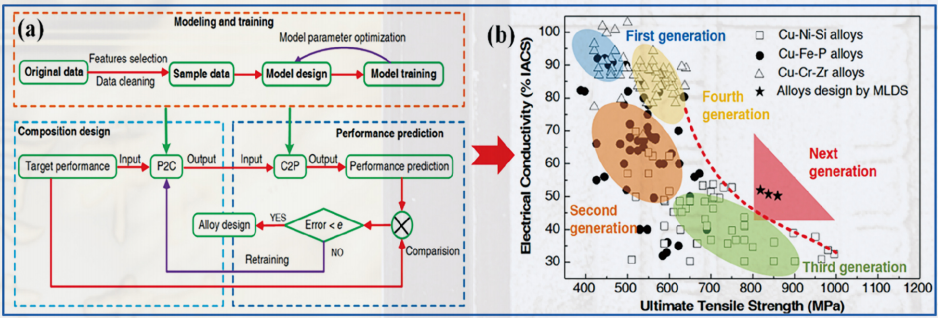
XIE highlighted how his research team at USTB applied machine learning techniques based on more than 300 text-mined datasets from scientific and technical literature to successfully identify key alloy factors that affect materials’ hardness and electrical conductivity. This discovery helped them obtain strengthened copper alloys with enhanced mechanical and electrical properties. “MGE can aid in testing millions of materials compositions and phases with high-throughput experiments and finding of alternatives for rare minerals with desired properties,” he adds.
Sustainable and reliable
Beyond materials discovery and improvement, USTB is applying MGE to optimize the manufacturing process. For example, automotive steel is usually manufactured through two stages featuring complex procedures and high energy consumption. Slabs are first hot-rolled and then cold-rolled to a desired thickness. Cars produced in this high-emitting way may be levied at a higher tax rate, or even restricted from export to the European Union countries according to the legislative proposal of ‘Fit for 55’.
A team led by MAO Xinping, a professor at USTB and an Academician of the Chinese Academy of Engineering, proposed a low-carbon short-process path to make automotive steel by deploying thin slab casting and direct rolling, which eliminates the cold rolling and annealing steps. This innovative approach can slash energy consumption by 71.5% while enhancing the steel’s overall performance.
The team also developed steels for cars, such as quenching-and-partitioning steel ― a type of steel with excellent strength and elongation, which is produced through a multi-step heat treatment. These steels are now being produced by the world’s top steelmaker, Baowu Group, and many thousands of tonnes of finished steel has been supplied to automakers both domestically and internationally.
Keeps on iterating
Researchers at USTB have been banking on another advanced material – carbon fibre reinforced polymers (CFRP), a choice for lightweight construction across many areas.
CFRP has been a hot topic in materials science since the 1990s, with recent research looking at refining its properties and scaling up using MGE approaches. A team led by YUE Qingrui, a professor at USTB and an Academician of the Chinese Academy of Engineering, has made great progress in research on CFRP’s reinforcement technology and new structures. Their reinforcement technology has been applied in many industrial and civil infrastructures, and a new CFRP cable developed by the team has been successfully applied in a stadium in Sanya, a city in China’s Hainan Province. Completed in September 2021, the-88,000-square-metre stadium with large-span space structure is the first of its kind in China to be constructed with CFRP cables.
So far, steel and CFRP are both commonly consumed in various circumstances through material modification. According to XIE Jianxin, advanced materials used to be relatively ‘slow’ to translate into practice, due partly to their relatively longer supply chain and trial-and-error R&D cycles. “That’s why we concentrate on growing MGE-based intelligent manufacturing, taking inputs from industries and iterating fast, to build sustainable and high-quality materials that will last,” Says XIE.
Beijing Advanced Innovation Center for Materials Genome Engineering
Launched with the support from Beijing Municipal Government in October 2017, the center strives to inspire the growth of emerging industries and high-end manufacturing with innovative solutions of materials genome engineering. It intends to develop high-quality materials that can be applied at a lower cost and higher efficiency by incorporating big data technologies and databases, high-throughput processing and characterization, computation approaches, and performance assessment. The center gathers top-notch talents and carries out frontier research, with the ultimate goal of transforming into a global leader in materials genome engineering.
State Key Laboratory for Advanced Metals and Materials (SKLAMM)
Established in 1990, the laboratory is committed to discovering advanced materials and upgrading traditional materials. To push the limits of metallic materials research and meet national development needs, five principal research directions have been formed: Frontier metallic materials, Novel functional materials, Advanced steels, Advanced materials processing, and Materials genome engineering. Over the last decade, it has made insightful contributions in design principles, preparation and application of advanced materials. SKLAMM will actively refine its research priorities to transform materials processing and raise its global profile.