Diseases and major outbreaks caused by pathogenic microorganisms (such as viruses, bacteria, etc.) pose a persistent and severe threat to human health. However, traditional nucleic acid detection technologies for pathogens have long faced the “sensitivity-cost-convenience” trilemma, where achieving high-sensitivity detection often comes at the expense of low cost and operational simplicity.
To overcome this challenge, a research team led by Prof. LI Zhengping, Dean of the School of Chemistry and Biological Engineering at the University of Science and Technology Beijing and an expert in molecular diagnostics and biochemical analysis, has innovatively proposed a sensing principle based on “target nucleic acid-driven hydrophilic-hydrophobic switching at interfaces”.
Building on this principle, the research team successfully developed the Ultrasensitive Single Tube Biosensor (USTB) nucleic acid detection platform. This platform achieves three groundbreaking breakthroughs: a detection cost of less than 1 $ for each sample, a limit of detection (LOD) with aM (1.0 × 10⁻18 mol·L⁻1) level, and visual readout of results within 1 min, completely eliminating reliance on large-scale specialized instruments.
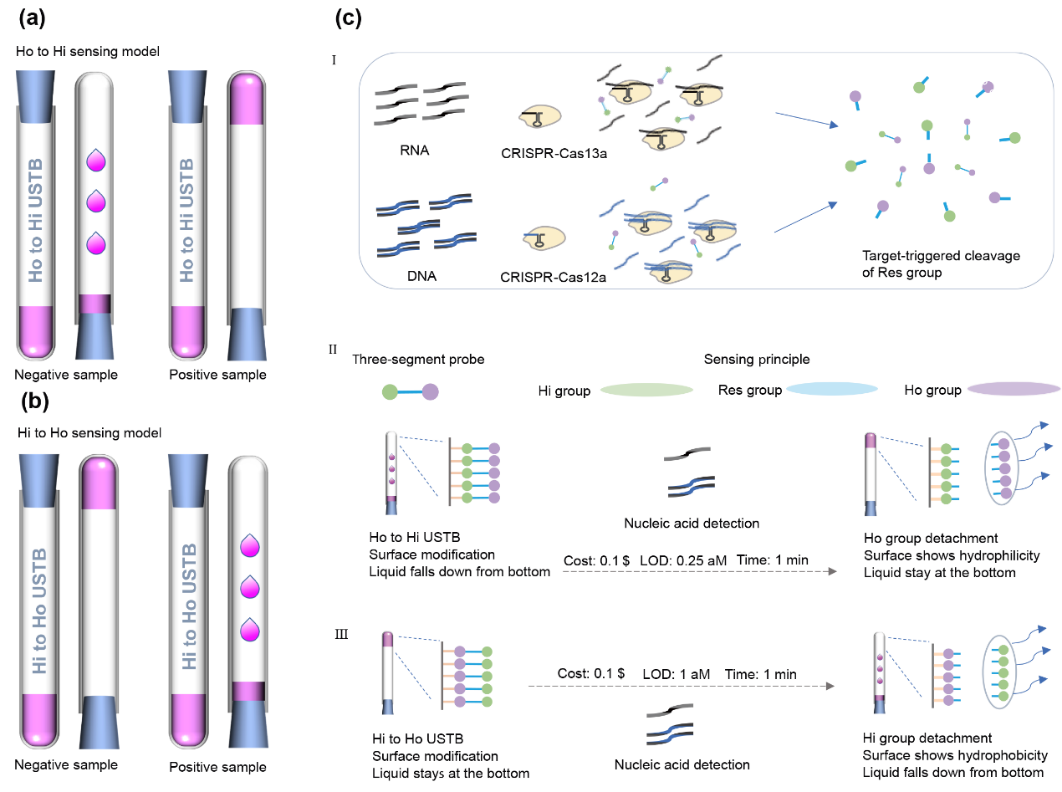
Working models and principles of USTBs: (a) illustration of the signal readout of the Ho to Hi sensing model; (b) presentation of the signal readout of the Hi to Ho sensing model; (c) schematic diagram of how the target RNA/DNA triggers the degradation of three-segment probe by the recognition and mediation of the CRISPR-Cas13a system and CRISPR-Cas12a system (I), the liquid motion state and the conformation of the three-segment probe on the surface of Ho to Hi USTB (II) and Hi to Ho USTB (III) before and after the target DNA/RNA was added.
“USTB is not merely an improvement upon existing technologies but represents an original innovation in sensing principles,” emphasized LI. “The USTB platform employs two detection models: hydrophobicity to hydrophilicity (Ho to Hi) and hydrophilicity to hydrophobicity (Hi to Ho). In Ho to Hi USTB, the liquid follows from the tube bottom when the tube is inverted without target molecules but remains at the bottom if targets are present. Conversely, in Hi to Ho USTB, liquid without targets hangs at the bottom but falls when targets are detected. USTB utilizes ‘CRISPR-Cas13a/12a’ systems and ‘three-segment probes’ (hydrophilic group, responsive group, and hydrophobic group) for nucleic acid sensing. ‘Cas13a’ degrades RNA-responsive groups upon RNA target recognition, while ‘Cas12a’ cleaves DNA-responsive groups for DNA detection. A single target triggers massive degradation, altering surface wettability and liquid behavior.”
“By deconstructing the nucleic acid probe recognition mechanism, signal response process, and signal readout mode in a disruptive manner, USTB demonstrates that ultra-sensitive nucleic acid detection can be achieved without relying on nucleic acid amplification reactions or complex photoelectric conversion equipment. This fundamentally overcomes the long-standing ‘trilemma’ that has plagued traditional nucleic acid detection.” says LI.
As elaborated in the research findings published online in Science Advances1 by LI’s team: “The core mission of future diagnostic technologies is to create a powerful tool that can be rapidly adapted and widely deployed during any outbreak, enabling real-time societal-level responses.” This vision is gradually becoming a reality through the practical application of the USTB sensing platform.
The USTB nucleic acid detection platform provides invaluable strategic technological reserves for China and the global community in combating major public health crises. Moreover, thanks to its universal design, USTB is suitable for rapid detection of all types of DNA/RNA. In the future, it holds promise for low-cost, high-sensitivity, and rapid early screening of a wide range of targets, including various viruses, bacteria, and cancer biomarkers. As nucleic acid detection technology becomes increasingly integral to clinical diagnostics, the emergence of innovative platforms like USTB will powerfully reshape the landscape of the entire nucleic acid testing industry.
REFERENCE
1. Li Z. et al. Sci. Adv. 11(18), eadu2271 (2025). https://doi.org/10.1126/sciadv.adu2271