These properties include the ability to stay the same size under extreme heat, and also the ability for materials to remain polarized for extended periods in the absence of an electric field, a phenomena known as ‘spontaneous polarization’.
“By controlling materials at the atomic level, we aim to create things we haven’t even dreamed of yet,” says Xianran Xing, a chemist and the director of USTB’s Institute of Solid State Chemistry. “Think of ultra-fast information storage, sensors capable of withstanding extreme conditions, or robust panels for aircraft.”
Institute of Solid State Chemistry, USTB, is well placed to achieve those goals. Established in 2019, it has quickly become a prominent player in solid state chemistry research.
Support from China’s National Key Research and Development Program — a major initiative aimed at fostering technological advances in key strategic areas — has allowed the institute to facilitate and establish advanced facilities such as the Scattered Neutron Source test platform, which is used to explore the internal structure and dynamics of materials.
“The challenge is to understand a material’s intrinsic properties, which depend on its chemical composition and crystal structure, and its atomic, charge and magnetic ordering,” says Xing.
Negative thermal expansion materials
An example of Solid Chemistry Institute researchers rising to that challenge is in the exploitation of NTE in ferroelectric materials — materials with the quality of spontaneous polarization.
In the early 2000s, Xing and his team revealed the mechanism of NTE in a classic ferroelectric material, lead titanate (PbTiO3), in temperatures up to 490 °C1. The research, covered in the journal Chemical Reviews in 20222, found that shifts in temperature trigger a specific atomic rearrangement called ferroelectrostriction (SVFS) which causes the material to shrink upon heating.
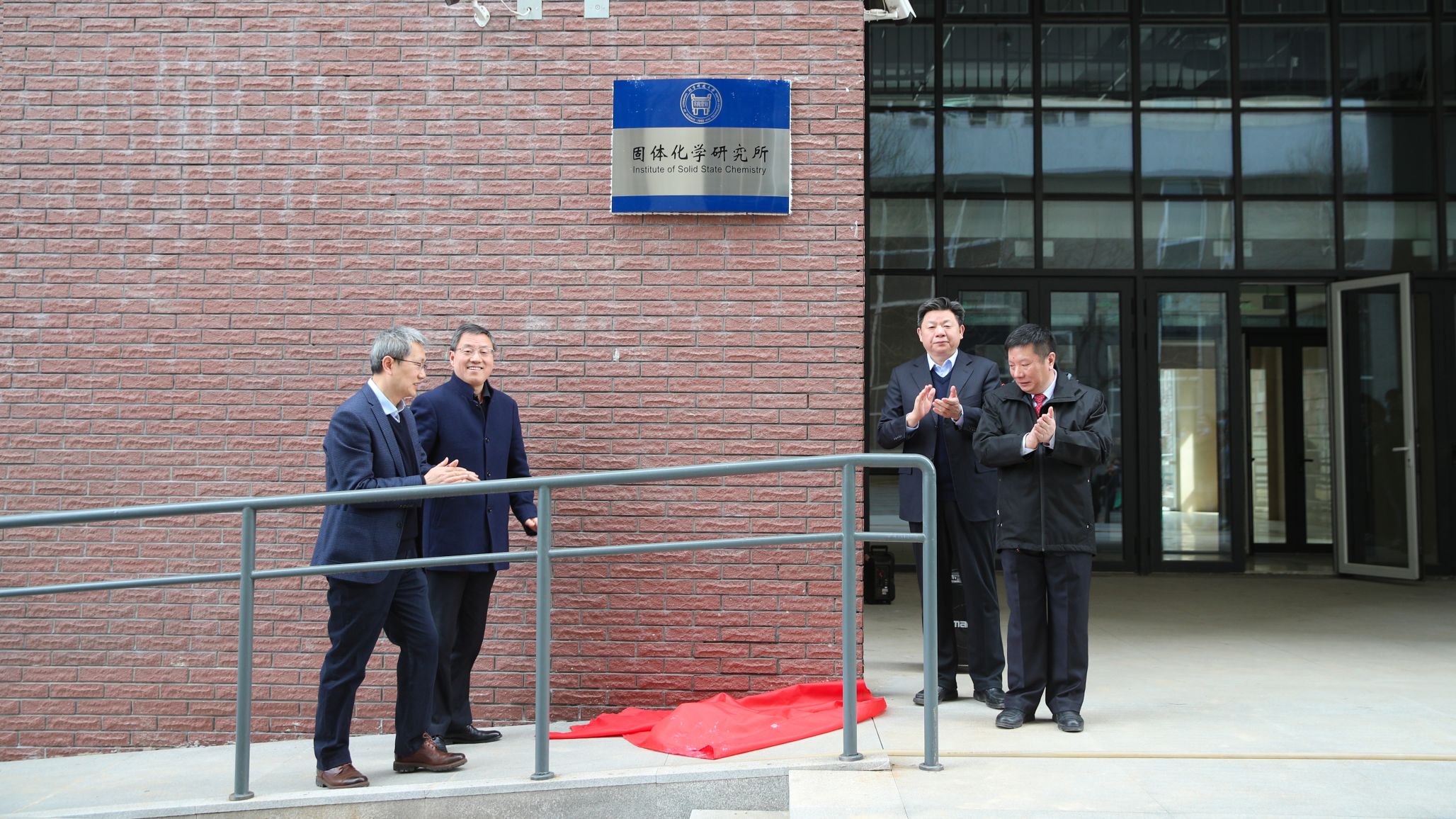
The opening of the Institute of Solid State Chemistry at the University of Science and Technology Beijing, where Xianran Xing (at far left) and his colleagues develop novel materials.
Xing and his team have discovered a series of ferroelectric-associated negative thermal expansion systems or NTEs. NTEs helps the novel ferroelectric materials maintain their shape in high temperature, making them potentially well-suited for aerospace components, energy storage, and other high-temperature applications, says Xing: “Understanding this is important because it provides new possibilities for the development of heat-resistant coatings, sensors and other devices.”
The institute’s contributions to the understanding of negative thermal expansion extends beyond research. Xing was instrumental in organizing the first International Conference on Negative Thermal Expansion in Beijing in 2015. It has since developed into a series of international symposiums, held in Japan, Italy, and the United Kingdom, with the fifth scheduled for Portugal in 2025.
Chemical Pressure
Material science developments are grounded in the rigor of the research approach. “We aim to develop novel materials with unusual properties, while providing a deeper understanding of the relationships between their chemical structures and properties,” explains Xing.
Take a concept such as ‘chemical pressure’ or chemical potential energy, he says. It determines the tendency of a substance to react in a particular way. Modulating chemical pressure to develop novel materials requires a thorough understanding of the material’s interfaces, lattices, and defects, and electronic structure, crystal structure, and magnetic structure.
In 2018, Xing’s team developed a process, using chemical pressure, to obtain a particular lattice parameter ratio to tetragonal atomic structure of lead titanate, or PbTiO3. This leads to a novel material with highest remanent polarization value ever recorded, almost doubling the value of all known ferroelectrics. The result was reported in Science3 in the same year.
By the same method, Xing and his team Xing introduced such chemical pressure to enable the preparation of high-performance materials, such as novel ferroelectric barium titanate or BaTiO3 films, which have uses in electronic devices that can store information with great stability.
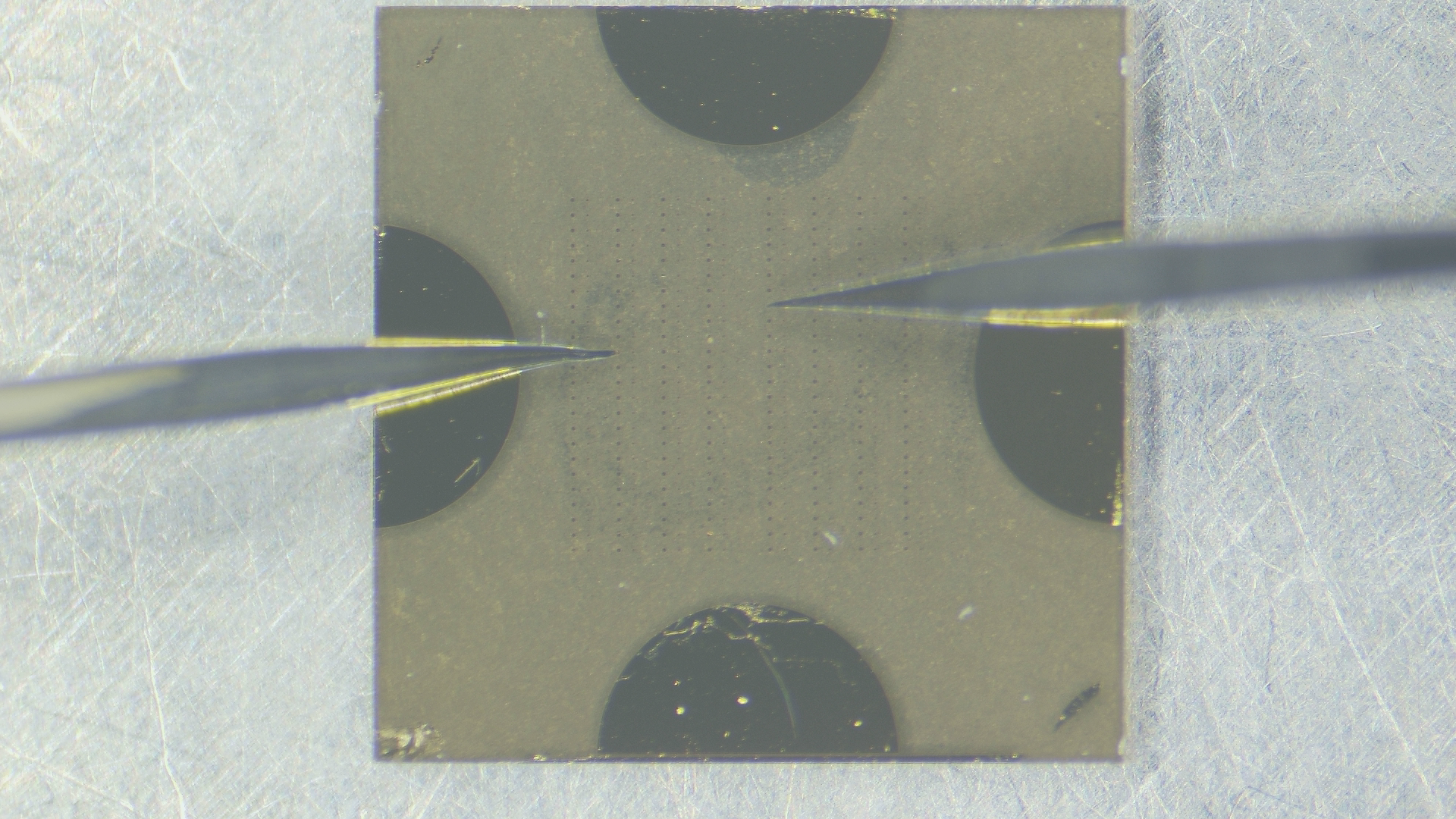
A super-thin film of barium titanate. The atoms in the film remain polarized in the absence of an electrical field, a phenomenon called ‘remanent polarization’. The material has potential for use in advanced electronics.
The atoms in these super-thin films remain polarized in the absence of an electrical field, a phenomenon called ‘remanent polarization’, which is the essential property for electronic devices that can store information without needing power all the time. Xing and his team developed BaTiO3 films with the highest spontaneous remanent polarization ever recorded, capable of withstanding temperatures exceeding 1000°C. The results were reported in the Journal of the American Chemical Soceity4.
Says Xing: “This material holds potential for advanced electronic components — capacitors, sensors and memory devices — which could improve the functionality of everyday gadgets.”